
Light Yield of CaWo4: Application of Birks' Model to CRESST-II Simulation Data
I completed this research project as part of my master's program in Technical Physics at TU Wien.
CRESST is an underground experiment in Italy designed to detect dark matter – the mysterious invisible substance that makes up most of the matter in the universe but has never been directly observed.
As part of my research work, I ran computer simulations to understand how particles interact with the detector's crystal material (calcium tungstate). When particles hit the crystal, they produce both light and heat, and the ratio between these signals helps identify what kind of particle caused the interaction. I used physics models to predict how much light different types of particle collisions should produce, then compared my simulations with real experimental data. This work helps the collaboration distinguish potential dark matter signals from background noise caused by other particles.
Key facts
- Project: Research project in the context of the Technical Physics master's program at TU Wien, Austria
- Collaborations: CRESST (Italy, Germany, Austria)
- Institute: Institute of High Energy Physics (HEPHY, Austria; now the Marietta Blau Institute (MBI))
- Date: July 2016
- Time invested: 9 months
- Keywords: particle physics, dark matter, detector simulation, data analysis
Abstract
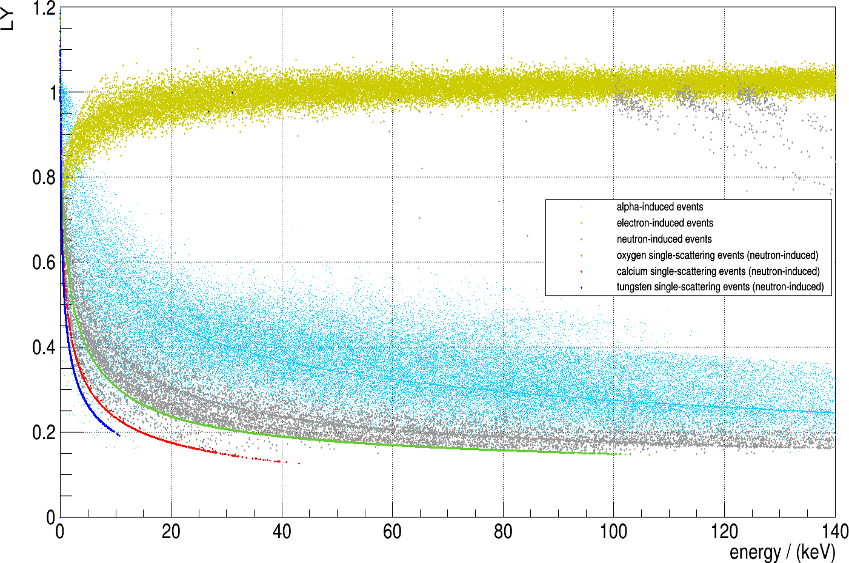
In the CRESST-II Direct Dark Matter experiment, particle interactions in the detector material CaWO4 are identified by analyzing their signatures in both the photon and the phonon channel in form of scintillation light and heat, respectively. In this work, neutron radiation onto a cubic CaWO4 crystal was simulated using standard Geant4. The light yield was modeled by employing Birks' Law and extracted from the simulation data with ROOT. Several distinct recoil bands emerge in the light yield-energy plane, which can be attributed to electrons, alpha particles as well as nuclei of oxygen, calcium and tungsten. For events involving single-scatterings on O or Ca only an empirical fit function was proposed and applied to the data. Subsequently, the simulated light yield of oxygen and calcium single-scatterings at a recoile energy of 400 keV was compared with experimental data described by a phenomenological parametrization. The results are LYO≈(Er ≈ 400 keV) = 0.09191 ± 0.00002 vs. LYOpar(Er = 400 keV) = 0.10677 ± 0.00009 and LYCasim(Er ≈ 400 keV) = 0.06314 ± 0.00030 vs. LYCapar(Er = 400 keV) = 0.06630 ± 0.00103. Additionally, a variation of the material-dependent Birks constant kB was performed. It showed that a variation of kB of less than a factor of two is sufficient in order to rescale the simulated light yield to the experimentally observed one.