
Search for long-lived particles decaying to a pair of muons in proton-proton collisions at 13 TeV (JHEP Publication)
This publication describes the results of an international effort to search for unknown, long-lived particles that decay into pairs of muons and leave distinctive particle tracks in the CMS detector. Detecting such a signal would mean the discovery of new fundamental physics.
Located at CERN's Large Hadron Collider (LHC), the CMS experiment is a massive underground detector specialized in capturing the tracks of millions of particles created by high-energy proton collisions.
While my PhD thesis focused on a particular subsystem of the CMS detector, the publication at hand summarizes the findings of our much more holistic search for these particle signatures. Our statistical data analysis did not find such a signal, but it significantly constrained the possible parameter space for these particles, providing crucial guidance for future searches.
Key facts
- Project: Publication of the CMS search for displaced dimuons
- Collaborations: CMS (CERN, Geneva, Switzerland)
- Date: May 2023
- Time invested: 3 years 8 months
- Links:
- Keywords: high-energy particle physics, proton-proton physics, long-lived particles, LLP, displaced muons, displaced dimuons, dark photons, Hidden Abelian Higgs Model, exotic particles, BSM physics
Abstract
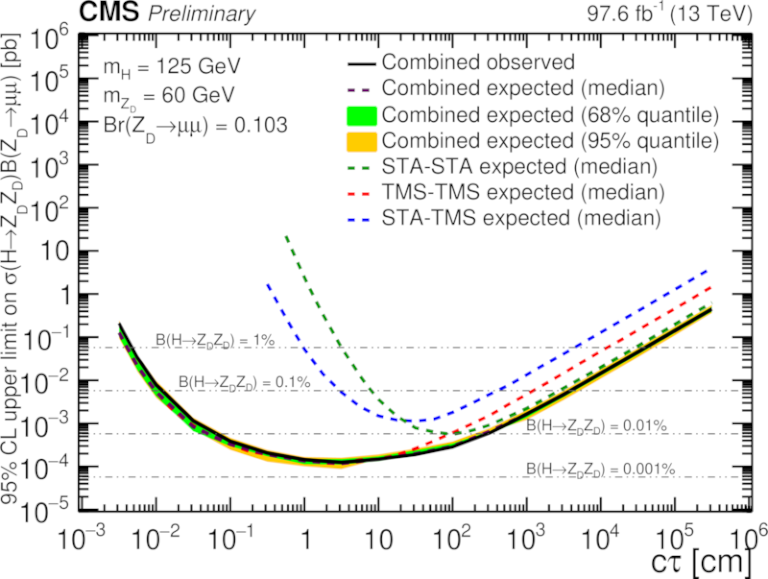
An inclusive search for long-lived exotic particles decaying to a pair of muons is presented. The search uses data collected by the CMS experiment at the CERN LHC in proton-proton collisions at √s = 13 TeV in 2016 and 2018 and corresponding to an integrated luminosity of 97.6 fb-1. The experimental signature is a pair of oppositely charged muons originating from a common secondary vertex spatially separated from the pp interaction point by distances ranging from several hundred µm to several meters. The results are interpreted in the frameworks of the hidden Abelian Higgs model, in which the Higgs boson decays to a pair of long-lived dark photons (ZD), and of a simplified model, in which long-lived particles are produced in decays of an exotic heavy neutral scalar boson. For the hidden Abelian Higgs model with m(ZD) greater than 20 GeV and less than half the mass of the Higgs boson, they provide the best limits to date on the branching fraction of the Higgs boson to dark photons for cτ(ZD) (varying with m(ZD)) between 0.03 and ≈0.5 mm, and above ≈0.5 m. Our results also yield the best constraints on long-lived particles with masses larger than 10 GeV produced in decays of an exotic scalar boson heavier than the Higgs boson and decaying to a pair of muons.