
Search for displaced dimuons in proton-proton collisions at 13 TeV with the CMS muon system (PhD thesis)
I wrote my dissertation after conducting research in the CMS collaboration for more than 3.5 years.
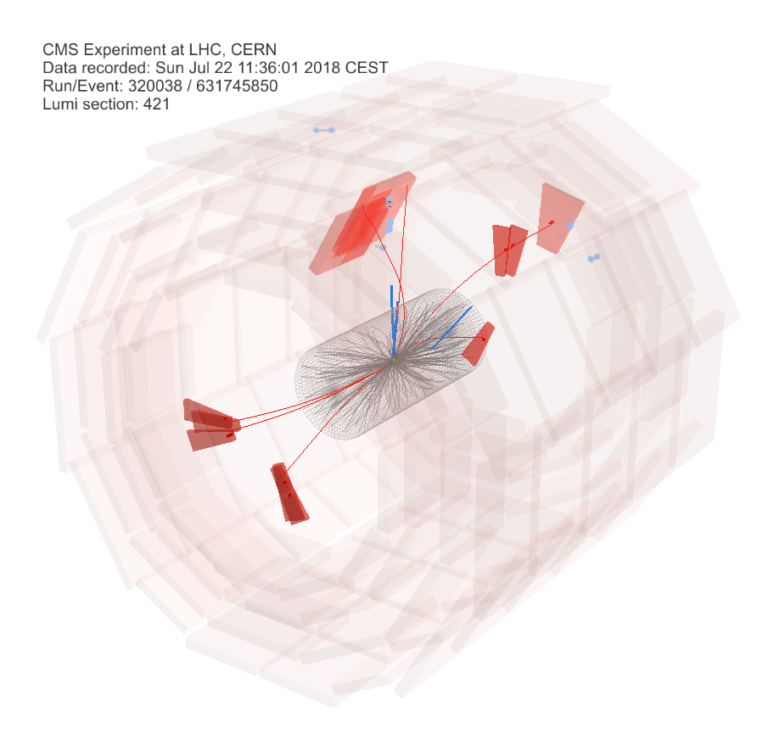
Located at CERN's Large Hadron Collider (LHC), the CMS experiment is a massive underground detector specialized in capturing the tracks of millions of particles created by high-energy proton collisions.
As a PhD candidate, my main responsibilities were to study the effect of muon particles traversing the detector off the central collision point. Based on these insights, I searched for off-center pairs of muons that are consistent with having originated from an "invisible," unknown mediator particle (which was itself produced in proton-proton collisions) under certain generic physics scenarios. Detecting such a signal would mean the discovery of new fundamental physics. Our statistical data analysis did not find such a signal, but we significantly constrained the parameter space for such particles, providing crucial guidance for future searches.
Read my PhD thesis to find out all the details.
This written dissertation contains only one part of a much more elaborate data analysis, which we eventually published in the Journal of High Energy Physics (JHEP).
Key facts
- Project: Dissertation (TU Wien, Austria)
- Collaborations: CMS (CERN, Geneva, Switzerland)
- Institute: Institute of High Energy Physics (HEPHY, Vienna, Austria; now the Marietta Blau Institute (MBI))
- Date: November 2021
- Time invested: 3 years 8 months
- Links:
- Keywords: high-energy particle physics, proton-proton physics, long-lived particles, LLP, displaced muons, displaced dimuons, exotic particles, BSM physics
Abstract
Long-lived particles (LLPs) naturally appear in many well-motivated theories beyond the Standard Model of Particle Physics (SM). These LLPs could be produced in high-energy particle collisions and subsequently decay into known particles, which can be detected a measurable distance away from the LLP point of creation. This work presents an inclusive search for neutral, exotic LLPs in events with pairs of oppositely-charged muons originating from a common displaced vertex. The underlying dataset was recorded by the CMS detector during the LHC Run 2 and comprised an integrated luminosity of 97.6 fb-1 of proton-proton collisions at a center-of-mass energy of 13 TeV. The search is sensitive to LLP decays beyond the CMS tracking system because it uses muons reconstructed by the CMS muon detectors only. To measure the relevant muon trigger and reconstruction efficiencies as a function of displacement and to assess systematic uncertainties and scale factors in the analysis, performance studies were carried out with cosmic-ray muons recorded by CMS in 2016. The results are interpreted in the context of two benchmark models: (1) a scenario in which the final-state muons are the decay products of a generic long-lived, scalar boson from a non-SM Higgs initial state (“BSM heavy scalar” model), and (2) the “Hidden Abelian Higgs model” which features long-lived, scalar dark photons as the intermediate LLP states giving rise to displaced dimuons in the final state. Upper limits on the production cross-sections in both interpretations are presented for a wide range of LLP mass-lifetime hypotheses. In all scenarios, there is good agreement between expected and observed upper limits and no statistically significant excess over the predicted SM background is reported.